- Latestly AI
- Posts
- Adobe Charges $540. Canva Said “Make It Free"
Adobe Charges $540. Canva Said “Make It Free"
Canva’s $0 power move just rewrote the rules of creative software and showed every founder how AI can turn free into unstoppable growth.

Latestly AI
November 07, 2025
In partnership with

Top 3 Things You Need to Know:
Canva kills Adobe’s $540 paywall — Affinity Suite is now free for everyone.
AI powers the play — Canva’s Magic Studio turns “free” into a growth engine.
Founders, take note — Freemium + AI = 2025’s smartest business model.
Software sprawl? That’s SaaD.

Software was supposed to make work easier. Instead, most teams are buried under it.
That’s SaaD – Software as a Disservice. Dozens of disconnected tools waste time, duplicate work, and inflate costs.
Rippling changes the story. By unifying HR, IT, and Finance on one platform, Rippling eliminates silos and manual busywork.
HR? One update applies to payroll, benefits, app access, and device provisioning instantly.
Finance? Close the books 7x faster with synced data.
IT? Manage hundreds of devices with a single click.
Companies like Cursor, Clay, and Sierra have already left outdated ways of working behind – gaining clarity, speed, and control.
Don’t get SaaD. Get Rippling.
1. What’s the Battlefield?
Last week, Canva quietly detonated a bomb in the design world.
In a single announcement, it made the entire Affinity Suite Designer - Photo, and Publisher; free forever.
To put that in perspective: Adobe still charges $540 a year for the equivalent Creative Cloud plan.
Canva’s counter-offer? “Here, take it. No subscriptions, no strings.”
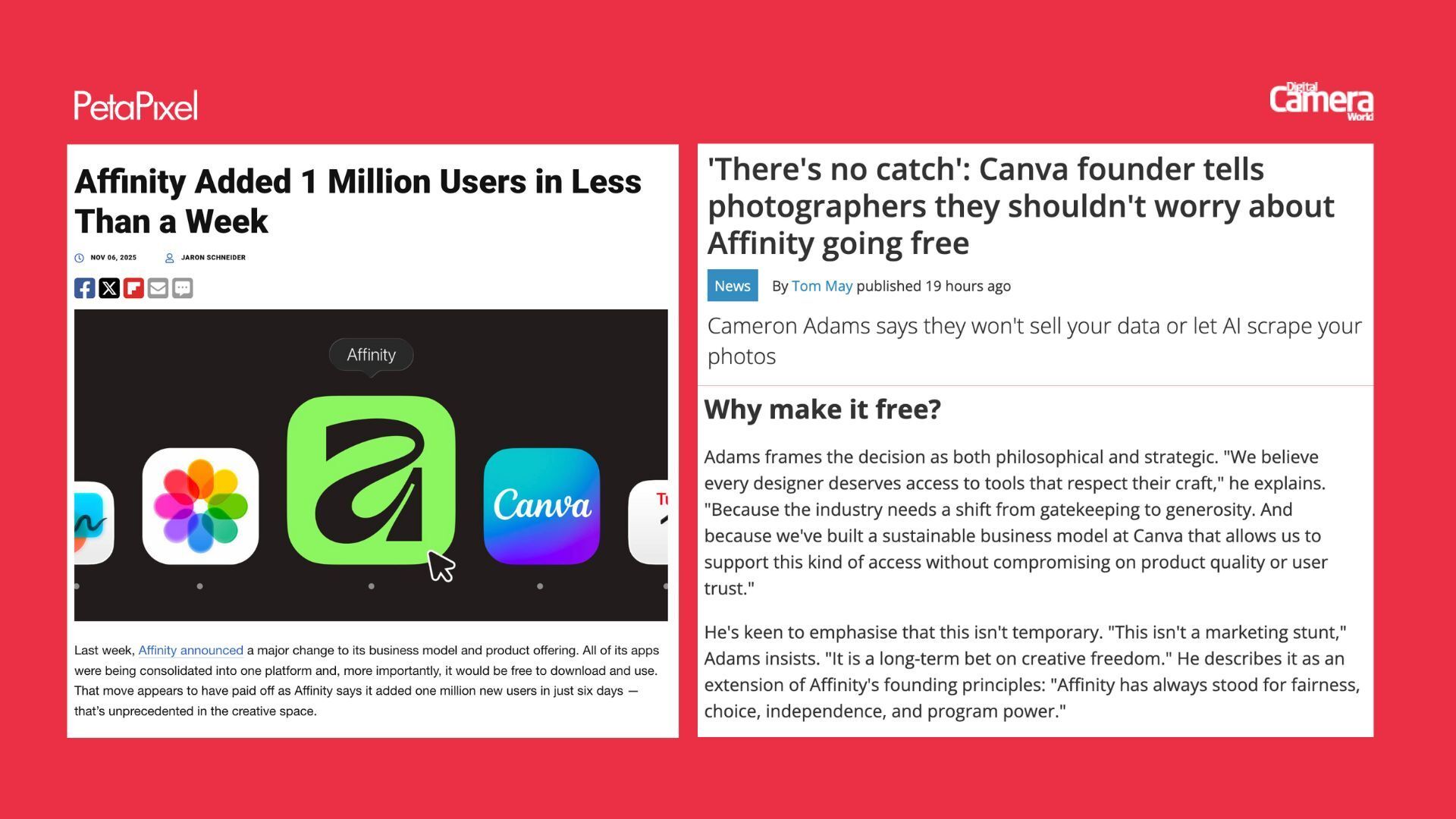
The internet went wild. Within 48 hours, more than a million new users downloaded the new Affinity, crashing servers and setting off a thousand think-pieces. But beneath the fanfare sits something deeper: a business masterclass in timing, technology, and trust.
Because this isn’t just about design.
It’s a signal flare for every founder navigating the AI era.
The Backdrop: From Drag-and-Drop to Dominant
Canva started in 2013 as a “PowerPoint for creatives.” It was light, simple, and let’s be honest; considered a toy by design pros.
A decade later, that toy is now worth $42 billion (Aug 2025) and runs the creative infrastructure of 170 million users across 190 countries.
When Canva acquired Serif Europe Ltd., the maker of Affinity, in 2024, most analysts expected the usual playbook: fold Serif’s software into Canva Pro, add a paywall, and call it a day.
Instead, CEO Melanie Perkins flipped the script:
“Design should be for everyone, not just those who can afford it.”
On 30 October 2025, Canva rolled out Affinity 2.5—a complete, professional suite for vector, photo, and layout design—free for life.
It’s the equivalent of giving away Photoshop, Illustrator, and InDesign at once.
The move went viral on X (formerly Twitter). Creators called it “the single most generous drop in software history.”
The Strategy Behind the Move: The Freemium Flywheel
Canva isn’t running a charity. It’s running a funnel.
At the top sits free creative software, a magnet for professionals who previously ignored Canva’s “beginner” image. Once they enter the ecosystem, the upsell path is clear:
AI tools (Magic Studio, Magic Write, Magic Switch)
Pro collaboration tiers
Premium Tools & Assets
Cloud storage and brand-management seats
It’s the Creative OS strategy: own every step from idea → design → publish → share.
By contrast, Adobe’s Creative Cloud depends on recurring licences and heavy desktop installs - great for revenue, slow for evolution.
Canva’s bet is different: use AI to subsidise creation. The more people design, the smarter (and cheaper) Canva’s AI becomes. That’s the “Freemium Flywheel.”
The AI Inside Canva’s Creative OS
This is where Canva truly flexes.
Under the hood, Magic Studio powers a suite of generative-AI tools that rival standalone apps:
Magic Edit: object removal & replacement using diffusion models.
Magic Expand: outpainting that predicts missing pixels using context-aware transformers.
Magic Write: GPT-style copy generation trained on Canva’s anonymised dataset of millions of templates.
Magic Switch: auto-localisation and layout transformation (e.g., turning a poster into a LinkedIn carousel).
AI Layout: transformer-based composition engine that studies millions of human-designed grids to suggest balance, hierarchy, and rhythm.
(Source: Canva AI Docs 2025)
Canva has quietly built partnerships with Runway ML, Stability AI, and its own internal LLM research team in Sydney to train these models.
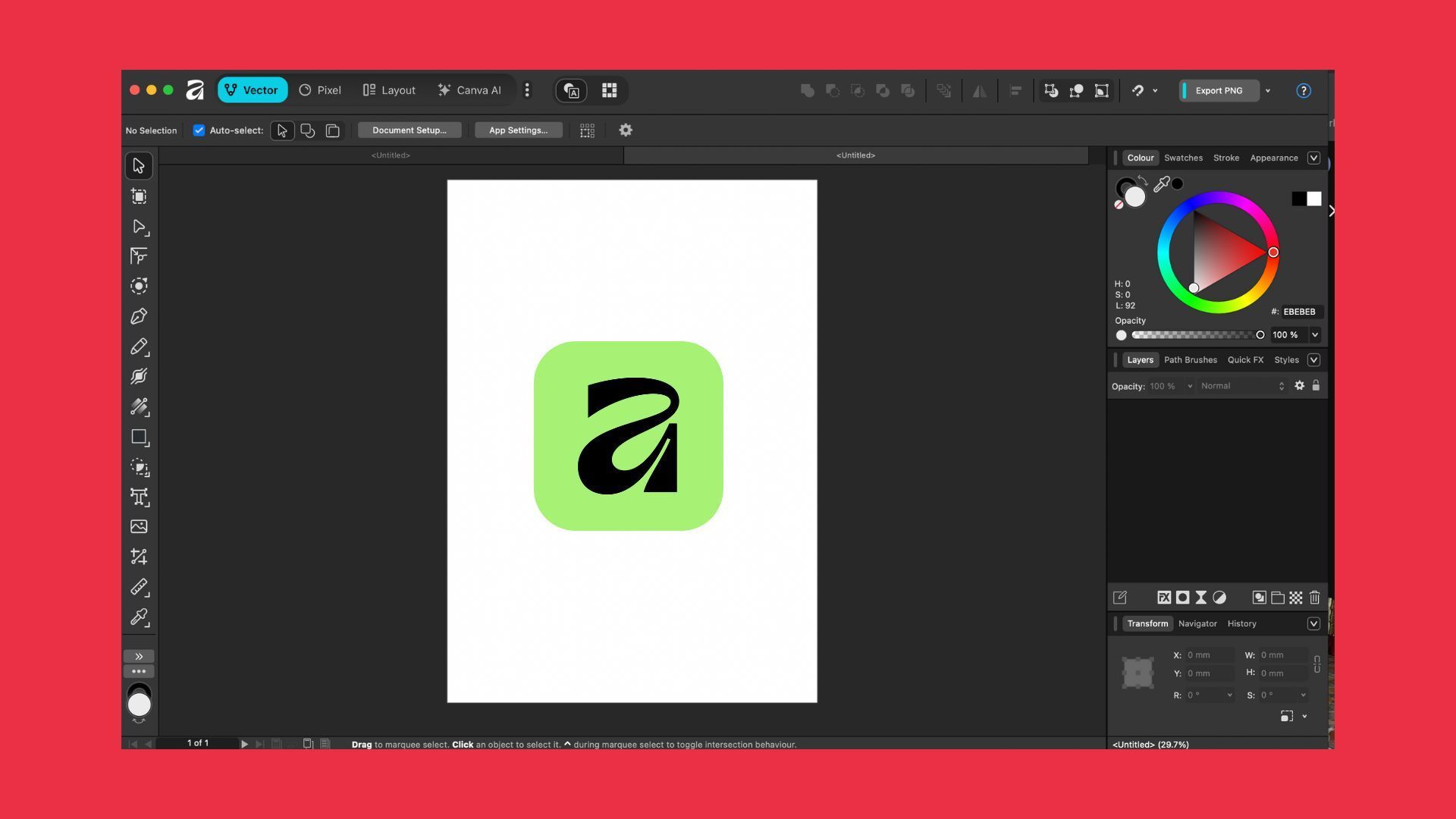
And the genius move? These same AI hooks are now baked into the Affinity Suite.
That means pro-level designers get precision tools layers, curves, masks plus one-click AI that removes friction.
As one beta-tester put it:
“Canva didn’t just automate design. It automated creative judgment.”
Business & Founder Takeaways
Freemium Done Right:
“Free” isn’t a revenue loss; it’s customer acquisition at scale. Canva gives away the high-friction tool (design software) to sell the high-margin one (AI automation).
Timing Is Everything:
The announcement lands as startups slash software budgets and creative teams consolidate subscriptions. In 2025, “zero-cost adoption” is the ultimate growth hack.
AI as Moat:
Adobe has the content graph (decades of creative assets). Canva now owns the workflow graph: millions of real-time user actions feeding AI training loops that continuously improve suggestions and layouts.
Speed Advantage:
Canva’s web-native architecture allows for instant AI feature deployment. Adobe, built on legacy desktop stacks, ships at enterprise speed. Canva iterates like a SaaS startup.
For Founders & Operators: Lessons from the Play
Pricing psychology:
Free builds trust. Once users are in, they’ll happily pay to remove friction (automation, cloud sync, brand controls).
AI leverage:
Use AI to collapse production costs. Canva’s AI replaces manual QA (colour correction, copy edit, resizing), letting them reinvest in user acquisition.
Platform flywheel:
Every design made in Canva feeds the dataset that powers better AI. More users → smarter models → better output → more users. That’s compound defensibility.
Strategic risk:
Free compresses short-term margins, but creates long-term lock-in. For founders, the lesson is clear: build moats around workflow, not features.
The Wider Implications
For indie developers:
The bar for “free” just moved. Competing on price is no longer viable; niche, speed, and UX matter more.
For SaaS founders:
Welcome to AI-enabled commoditisation. If your value can be replicated by a model, your differentiation must come from integration, brand, or community.
For creators:
Design no longer requires capital. The downside? Skill signalling erodes when everyone can make a polished brand kit, taste and storytelling become the new edge.
Case Study — The AI Economics Behind “Free”
Let’s do founder math.
Suppose Canva’s AI removes 70 % of support, onboarding, and QA costs per user. The marginal cost per new Affinity install drops near zero.
At 1 million new users in week one, even if 5 % convert to $20 Pro plans, that’s $12 million ARR right there plus priceless market capture.
AI automation doesn’t just make “free” possible; it makes free profitable.
Canva vs Adobe: The Tale of Two Worlds
Metric | Canva + Affinity (2025) | Adobe Creative Cloud (2025) |
|---|---|---|
Price | $0 base; $20 Pro AI tier | $540 / year subscription |
Core Model | Freemium + AI workflow | Subscription + licensing |
User Base | 170 M+ monthly active | ~30 M Creative Cloud |
AI Focus | Magic Studio (image, copy, layout) | Firefly GenAI suite |
Tech Stack | Web-native, cloud-first | Desktop-heavy, cloud sync |
Strategy | Capture all creation | Monetise core tools |
2025 Signal | Democratise > Monetise | Defend > Expand |
What Founders Can Steal from Canva’s Playbook
Attack the monopoly through generosity.
Free is the loudest marketing channel on earth.
Build a data moat before a revenue moat.
AI models trained on user workflows are harder to clone than code.
Time disruption during cost crises.
Canva launched this amid a SaaS-spending winter, perfect storm for adoption.
Sell time, not tools.
Canva isn’t selling software anymore; it’s selling hours saved.
The Closing Take
In a world where AI makes creation instant, distribution, community, and workflow lock-in will decide who wins.
For founders watching from the sidelines: the next big disruption in your industry might not come from a competitor with more funding; it might come from one willing to make its product free, and use AI to pay for it.
💡 Found this breakdown useful?
Subscribe to Latestly AI Premium for AI intelligence in one scroll that always makes you smarter.
If you enjoyed this read, unlock deeper AI insights with our premium newsletter.
Start your free 7-day trial today 👇.

Marco Fazio,
Editor, Latestly AI,
Forbes 30 Under 30
How was this edition?
We hope you enjoyed this Latestly AI edition.
📧 Got an AI tool for us to review or do you want to collaborate?
Send us a message and let us know!
Was this edition forwarded to you? Sign up here