- Latestly AI
- Posts
- The AI Skills That Will Make People Rich in 2026
The AI Skills That Will Make People Rich in 2026
The skills, tools, and roles turning AI fluency into real income

Latestly AI
January 02, 2026
If 2025 was the year of AI promise, then 2026 is the year AI has to deliver real value on business metrics. That simple shift changes everything for anyone working with AI, from product leads and engineers to revenue teams and consultants.
1. Prompt engineering is no longer a moat.
2. AI operators will out-earn AI generalists.
3. Vertical AI beats generic tools.
Here is a deep view of the 2026 AI market, what it means for operators, where money will be made, which skills matter, and the tools that will define success.
AI in 2026: Where the Market Is Headed and How Operators Can Make Money

AI Shifts From Experimentation to Enterprise Value
The most consistent prediction from industry experts is that in 2026, AI moves from isolated experiments and pilots into mainstream business operations. Organizations are no longer asking whether AI is useful, but how it can measurably improve performance, reduce cost and accelerate workflows. AI adoption and usage is rising sharply, with many companies reporting productivity gains from AI in core functions like software development, manufacturing troubleshooting and R&D collaboration. In fact, enterprise level usage of AI surged significantly in 2025 and continues into 2026 as more companies scale beyond initial pilots with defined KPIs.
For operators this means one thing: the bar for success is no longer novelty but business impact. Tools that produce ROI will be adopted quickly. Teams that can quantify value, measure outcomes and show business improvement will be the ones that win.
What to watch
AI integrated into core workflow systems rather than stand-alone tools
Demand for AI solutions tied to measurable KPI improvement
Enterprises investing in AI that directly affects revenue, cost and customer experience
A Market Correction Is Coming but with Golden Opportunities
As AI continues to grow, many investors are warning of a market cleanup in 2026. Venture capitalists are predicting that AI companies that lack clear economic moats, solid revenue paths or defensible technology will get weeded out. The early gold rush phase where easy capital flowed to any AI idea is ending and making way for rigorous, execution-focused companies.
This is good for the ecosystem. It will reveal where real value is being created and push resources toward operators who can actually build, deliver, scale and measure performance.
For operators, this means:
Specialize in delivery and execution rather than just experimentation
Focus on products that solve industry problems at scale
Emphasize revenue models that align with value delivery, not just usage metrics
Enterprise Adoption Will Be the Defining Trend of 2026
According to trend reports, one of the biggest shifts in 2026 will be enterprise-wide AI deployment replacing ad hoc pilots. Instead of small pockets of AI use, companies are now pushing for company-wide integration of AI into business processes. Leaders are centralizing decisions around AI investment and aligning them with top down strategies. 
This shift has huge implications for operators. When AI becomes a cross-organizational priority:
• Budget and attention go where the impact is clearest
• Teams that speak both business and AI fluently get influence and funding
• Product decisions are driven by business outcomes, not technology alone
Operators who can translate business workflows into AI-enabled processes will be in high demand.
Agents, Orchestration and Automation Replace Prompt-Only Interfaces
One of the biggest technical shifts expected in 2026 is the evolution of AI from prompt-centric tools to autonomous systems that manage real workflows. Research and trend analysis show that 2026 will be the year where AI systems increasingly act as agents within business processes, not just assistants that respond to requests. 
Instead of asking AI for output, businesses will use AI to navigate, act, monitor and optimize tasks across systems. This requires:
• Contextual intelligence that understands business state
• Orchestration layers that connect multiple models and data sources
• Trust and governance frameworks to ensure AI acts appropriately
For operators, this is a fundamental shift. Prompt engineering will not go away, but it will no longer be the centerpiece of AI product strategies. Instead, context engineering, workflow integration and proactive AI orchestration become core skills.
Data Quality and Content Strategy Become Mission Critical
A common theme in 2026 forecasts is that AI success won’t just be about models — it will be about the data those models use. If data is messy, inconsistent or poorly structured, AI will produce poor results regardless of how advanced the model is. In 2026, organizations that prepare their data strategically — governance, metadata, semantic context — will unlock far more value. 
This means operators need to think holistically about:
• Data pipelines and quality processes
• Content platforms that can feed AI with reliable information
• Structures that allow AI to operate with certainty rather than ambiguity
Operators who can master data readiness will be essential in scaling AI successfully across business functions.
The Skills That Will Pay in 2026
AI tools are proliferating fast but the human skills that complement AI are not keeping up. Employers in 2026 will pay premiums for professionals with a mix of technical and human-centered skills. This means not only technical fluency but also strategic judgment and the ability to work with AI as a collaborator. 
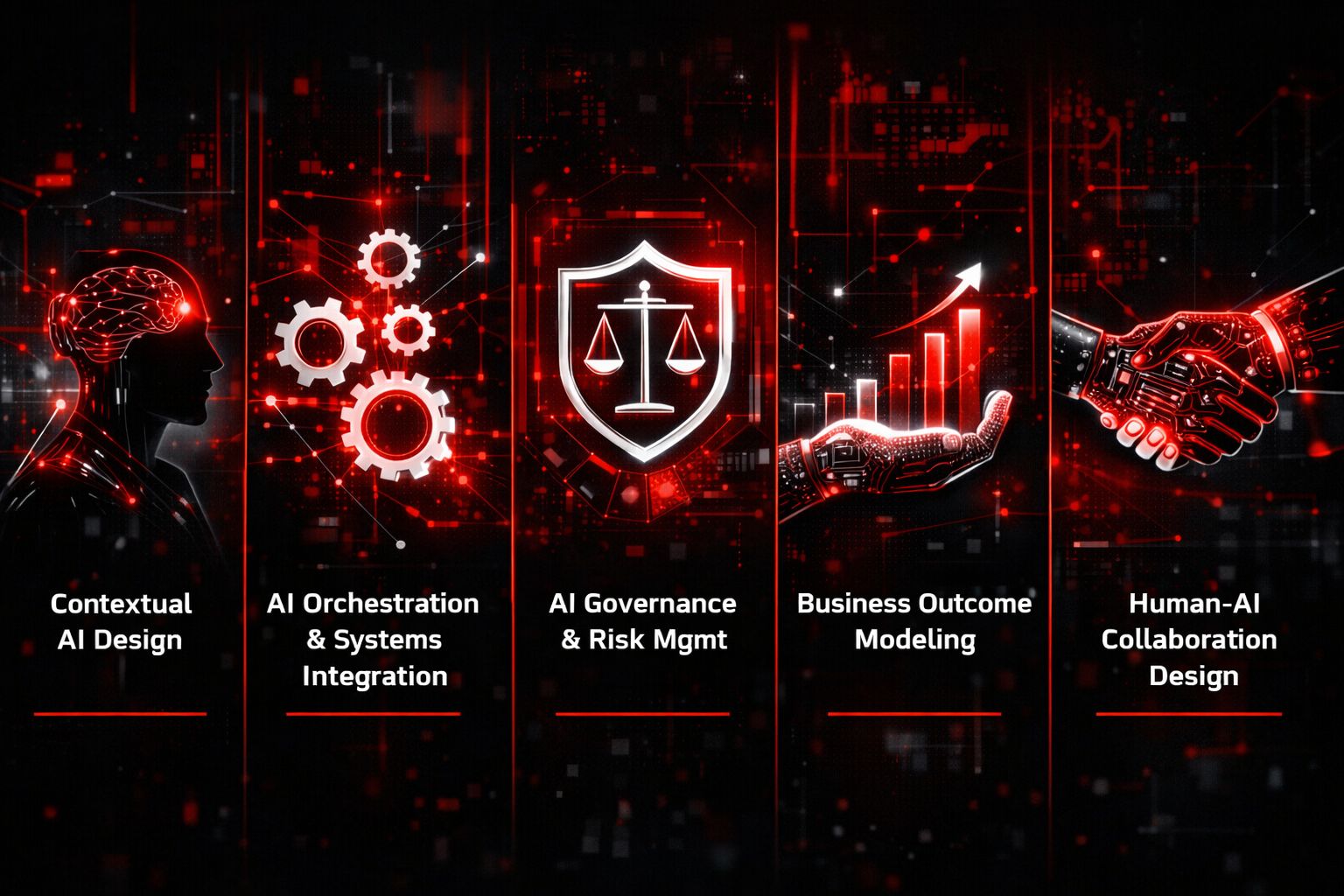
High-value skills for AI operators in 2026
1. Contextual AI design — Understanding workflows and embedding AI into them
2. AI orchestration & systems integration — Connecting models, data, APIs, and business logic
3. AI governance & risk management — Mitigating bias, ensuring compliance and establishing trust
4. Business outcome modeling — Quantifying impact and tying AI outputs to ROI
5. Human-AI collaboration design — Designing interfaces and workflows where humans and AI co-create
The operators who can combine technical capability with business savvy and people skills will be the ones commanding the best roles, projects and opportunities.
Monetization Paths for AI Operators
2026 isn’t just about working with AI tools — it’s about making money from them. Opportunities spread across multiple verticals and roles:
AI Implementation Consulting
Companies will pay handsomely for experts who can deploy and integrate AI into existing systems, reduce risk, and measure improvement. This is especially true for small and medium enterprises that lack internal talent.
AI Product Operations
Operationalizing AI at scale means institutions need specialists who can manage deployments, solve data issues, and continually improve performance.
Vertical AI Solutions
Industry-specific AI applications (health, legal, finance, supply chain) generate the best unit economics because they solve hard, money-leaking problems.
AI Training & Strategy
There is growing demand for training programs that help teams adopt AI safely and effectively. Operators who can teach both teams and executives will find lucrative markets.
AI Governance & Compliance Services
As AI systems become responsibilities of entire organizations, people who understand risk, safety, fairness and auditability will be essential. Formal roles and consultancies will emerge around AI compliance frameworks.
Tools and Systems That Will Define 2026
The tools that matter in 2026 are not just generative models. They are the ecosystems that allow AI to operate inside real business environments.
AI Orchestration Platforms
Tools that connect multiple models, services, APIs and processes. These are the systems that turn isolated AI capabilities into composable business logic engines. 
Context Stores
Beyond prompts, the next phase requires systems that track state and context over time so AI can make decisions based on business history, current workflow state and user behavior.
Agent Frameworks
Agentic systems that can reason, act and execute tasks across systems with supervision become primary productivity tools.
Governance and Monitoring Dashboards
Operational AI success requires observability — tracking performance, drift, bias, security and compliance in real time.
The Year of Measurable Outcomes
Ultimately, 2026 is not going to be judged by model size, hype cycles, or feature lists. It will be judged by measurable outcomes — cost saved, revenue gained, time reduced, decisions improved.
Organizations, investors, and executives are now demanding impact, not abstraction. AI operators should embrace this shift because impact converts directly into revenue.
In 2026:
• AI isn’t a novelty tool — it’s an operational pillar of successful businesses. 
• Value beats hype, and those who can prove it will be rewarded. 
• Operators who can bridge business and AI will command premium opportunities.
If you want to thrive this year, orient your strategy not around models but around real business transformation.
Final Thought
2026 is the year AI stops being an experiment and becomes a workforce multiplier. It will replace tasks not jobs, and it will elevate operators who can combine human judgment, strategic thinking and AI execution.
Operators who focus on impact, integration, governance, and business outcomes — not just technology — will be the ones who turn AI into real income streams and career acceleration pathways.
This year, AI will prove whether it can deliver economic value at scale. And the operators who understand that early — and act on it — will be the ones who win.

We’re Considering Building Something Deeper
A few of you have asked for something beyond newsletters and breakdowns.
Not surface-level demos.
Not “watch me build a toy agent.”
But a clear, structured learning experience that explains:
how agents actually work (not the marketing version)
when workflows are the right answer and when they aren’t
how to think in constraints, escalation, and responsibility
how to design systems that hold up in real work
Before we build anything, we want to understand where you’re at.
Quick Poll (Pick What Resonates Most)What would be most useful for you right now? |
That’s it. No right answer.
We’ll shape what we build based on where the signal actually is.
A new year doesn’t need noise to begin well.
Thank you for being here and thinking alongside us.
Wishing you clarity, momentum, and the patience to build things that last.
Let’s make this a year of smarter systems and better decisions.
We hope you enjoyed this Latestly AI edition.
📧 Got an AI tool for us to review or do you want to collaborate?
Send us a message and let us know!
Was this edition forwarded to you? Sign up here