- Latestly AI
- Posts
- The Skill You’ll Regret Not Learning Before January
The Skill You’ll Regret Not Learning Before January
How GumLoop is turning AI from chat into operational systems and why agents + workflows are becoming the new baseline for operators

Latestly AI
December 26, 2025
In partnership with

Since many of you are easing into the holiday break, we’re keeping today’s edition focused and high-signal.
Instead of multiple stories, we’re zooming in on one shift that quietly defines where AI is actually going: away from reactive chat and toward agent-driven systems that orchestrate real workflows.
Why agents only work when paired with deterministic workflows,
Why operators (not prompt engineers) are the real power users, and
How small teams are building operational AI without hype.
We’ll end with a short poll to understand where you are on this curve whether you’re building mental models or already experimenting with agents in real workflows.
Think of this issue as a calm but important checkpoint before the year turns.
Turn AI Into Extra Income

You don’t need to be a coder to make AI work for you. Subscribe to Mindstream and get 200+ proven ideas showing how real people are using ChatGPT, Midjourney, and other tools to earn on the side.
From small wins to full-on ventures, this guide helps you turn AI skills into real results, without the overwhelm.

AI STORY OF THE WEEK
How GumLoop Is Quietly Turning AI From “Chat” Into Operational Infrastructure?
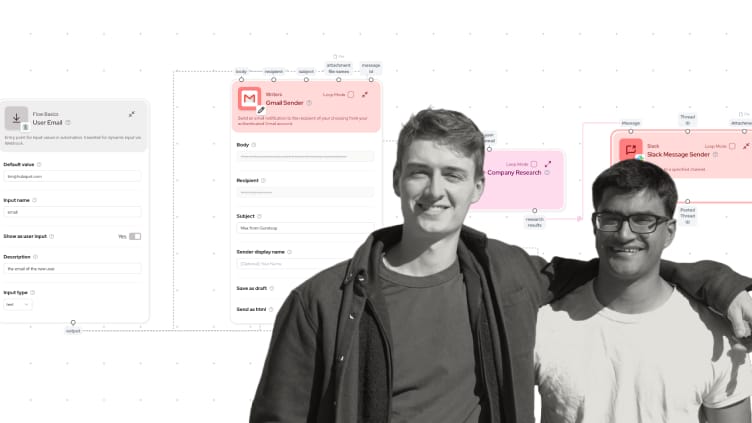
In 2025, GumLoop didn’t look like the future of AI if your benchmark was social media hype.
No viral copilots. No animated mascots. No loud claims about model size.
Instead, it looked like plumbing. And that’s precisely why it matters.
Behind GumLoop are Max Brodeur-Urbas and Rahul Behal, two founders who made a bet most AI builders avoided: that the real bottleneck in AI adoption isn’t intelligence, it’s operations.
Not “How smart is the model?” but “Can this system actually run real work every day without breaking?”
The Problem AI Tools Keep Dodging
Most AI products today are interaction-first. They assume the user notices a task, explains it clearly, provides full context, and supervises execution. That’s not assistance. That’s outsourcing typing.
Operators the people running newsletters, ops pipelines, support queues, CRMs, calendars, and content engines don’t struggle with thinking. They struggle with repeated judgment and context loss.
Every day looks like Gmail → Slack → Calendar → Sheets → Notion → CRM.
Context is copied. Rules are re-decided. Automations break on edge cases.
Most AI assistants simply add another surface where context must be re-entered.
Max and Rahul saw this clearly: if AI still waits for explicit prompts every time, it will never scale beyond novelty.
So GumLoop didn’t start with chat. It started with responsibility.
What GumLoop Is Actually Building
GumLoop is not AI automation in the Zapier sense.
It’s also not agents in the vague demo sense.
At its core, GumLoop is an agent orchestration layer built on three hard constraints:
Workflows remain deterministic and explicit
Agents reason only within allowed capabilities
Credentials and permissions mirror real-world access
This matters because most agent systems fail by being too loose: too many tools, unclear authority, unsafe actions, unpredictable cost. GumLoop is intentionally stricter.
Agents vs Workflows (The Technically Correct Distinction)
This difference is architectural, not philosophical.
Workflows are deterministic, cheap, fast, and predictable. They follow the same path every time and are best for high-volume, repetitive tasks like data enrichment, scheduled reports, notifications, and batch processing.
Agents are non-deterministic. They reason about context, choose which tools to call, and adapt to ambiguity. They are slower and more expensive, but essential for judgment-heavy work like scheduling, research, triage, and planning.
GumLoop does not replace workflows with agents. It turns workflows into tools that agents can call. This single design choice is what makes the system usable at scale.
Why This Matters for Operators
Operators don’t want flexibility for its own sake. They want reliable delegation.
GumLoop lets operators encode rules once, reuse deterministic logic safely, and let agents handle ambiguity without brittle branching.
You are not eliminating complexity. You are relocating it from UI wiring to system design.

A Technically Accurate Operator Example: The Calendar Maintainer Agent
This agent is not “add events to my calendar.”
It is an agent responsible for keeping a calendar accurate and compliant with personal rules.
First, you define responsibility in the system instructions:
“You are my personal calendar maintainer. Your responsibility is to keep my calendar accurate, realistic, and aligned with my working hours, buffer rules, and priorities.”
This sets authority, scope, and boundaries.
Next, you provide explicit tools: Google Calendar (read/write), Gmail or Slack (read-only), and optional helper workflows like “Check Availability” or “Propose Time Slots.”
Each workflow has clear inputs and outputs and does one thing well.
Then you encode constraints as hard rules: working hours, no late meetings, required buffers, protected deep work, personal weekends unless explicitly overridden. These are filters, not preferences.
You also define approval and escalation logic. New meetings require proposing options. Reschedules can auto-adjust if compliant. Cancellations always require confirmation. You are not pre-coding edge cases. You are designing escalation behavior.
When a message arrives like “Can we catch up tomorrow evening?”, the agent detects scheduling intent, extracts ambiguity, checks constraints, calls availability workflows if needed, proposes compliant slots, waits for confirmation, and only then creates or updates the calendar event.
There is no manual routing UI. No repeated field mapping. But deterministic workflows still exist underneath. That nuance matters.
What Is Actually Eliminated (And What Isn’t)
You do not eliminate field mapping entirely. It moves into reusable workflows.
You do not eliminate routing entirely. Agents become the router.
You do not eliminate edge cases. You replace pre-coding with escalation rules.
What you eliminate is repeated wiring, duplicated logic, brittle IF/ELSE trees, and constant supervision.
This is not magic. It is a layer shift.
Why This Feels Easier to Operators
Operators already think in responsibilities, constraints, exceptions, and outcomes. They do not think in blocks, routers, triggers, or schemas. GumLoop aligns the system with how operators already reason while keeping deterministic execution where it belongs.
Credentials, Permissions, and Safety
GumLoop agents use the credentials of the person running them, respect workspace access controls, and cannot exceed granted permissions. This prevents silent data access, cross-user leakage, and destructive actions without consent. It is unglamorous and absolutely necessary.
The Bigger Pattern GumLoop Is Enabling
Humans define responsibility.
Agents handle interpretation.
Workflows handle execution.
This is not no-code. It is no-micromanagement.
You stop managing steps and start managing systems.
Final Thought
Max Brodeur-Urbas and Rahul Behal didn’t try to make AI feel magical. They tried to make it operationally honest.
For operators drowning in tools, context switches, and fragile automations, that’s not a small upgrade. It’s a different way of working entirely.

This season looks different for everyone.
Some are resting.
Some are reflecting.
Some are quietly exploring what they want to build next.
And that’s a good thing.
Because the next wave of leverage in work isn’t about knowing more tools.
It’s about knowing how to design systems that reduce manual thinking over time.
Automation, workflows, and agents are becoming a core literacy: not just for engineers, but for operators, founders, and knowledge workers across roles.
We’re Considering Building Something Deeper
A few of you have asked for something beyond newsletters and breakdowns.
Not surface-level demos.
Not “watch me build a toy agent.”
But a clear, structured learning experience that explains:
how agents actually work (not the marketing version)
when workflows are the right answer and when they aren’t
how to think in constraints, escalation, and responsibility
how to design systems that hold up in real work
Before we build anything, we want to understand where you’re at.
Quick Poll (Pick What Resonates Most)What would be most useful for you right now? |
That’s it. No right answer.
We’ll shape what we build based on where the signal actually is.
However you’re spending the holidays - resting, reflecting, or gently exploring - you’re doing it right.
Thank you for being part of this community.
Wishing you a calm holiday season and a thoughtful, intentional New Year.
We’ll see you on the other side. Ready to build smarter systems?
We hope you enjoyed this Latestly AI edition.
📧 Got an AI tool for us to review or do you want to collaborate?
Send us a message and let us know!
Was this edition forwarded to you? Sign up here