- Latestly AI
- Posts
- These Startups Are Beating Google's Gemini & You've Never Heard Of It
These Startups Are Beating Google's Gemini & You've Never Heard Of It
Why "pain" in Tamil isn't the same as "pain" in Hindi, how 500 million regional language users are locked out of healthcare AI

Latestly AI
March 27, 2026
in partnership with

Top 3 Things in Today's Edition
Gnani.ai hit Rs 160 crore ARR (186% YoY growth) processing 10M daily calls across HDFC, Bank of Baroda, IDFC First. Claims to outperform Gemini on India-specific tasks.
Healthcare + legal AI captured $665M (51%) of this week's $1.3B in funding.
Businesses building lead gen and price monitoring on their platform capture 75-90% margins vs. $350K-$400K/year to build in-house.
AI STORY OF THE WEEK
India's Sovereign AI Bet: Why Gnani.ai and Sarvam Just Raised the Stakes
Three Indian startups deployed production voice AI for 73% of the country's internet users this month. The models process pain differently across dialects. Healthcare is noticing.
When Gnani.ai's CEO Ganesh Gopalan stood at the India AI Impact Summit on February 17, he wasn't pitching vaporware. His company's Inya VoiceOS was already processing 10 million calls daily across HDFC, Bank of Baroda, and IDFC First. The 5-billion-parameter voice-to-voice model handles Hindi, Tamil, Telugu, Kannada, Gujarati, and English without converting speech to text first—a technical detail that matters when 85% of Indians aren't fluent in English.
Two seats over, Sarvam AI's Pratyush Kumar unveiled Sarvam-105B, trained entirely on Indian infrastructure with Rs 246.72 crore ($30M) in government backing. Both companies claim their models outperform Gemini and ChatGPT on India-specific benchmarks. Google's Sundar Pichai was in attendance. He called the work "actually happening."
The technical achievements are real. What's unclear is whether "sovereign AI" solves actual problems or just repackages nationalist rhetoric. The answer appears to be both, with healthcare emerging as the clearest use case.
The Pain Description Problem
Research published in the Journal of Pain shows that Hindi speakers use fundamentally different pain descriptors than English-speaking populations. A 2024 study examining 240 patients with chronic musculoskeletal pain found that none of the standardized Western pain assessment tools were content-valid for Hindi speakers. The most commonly used tool only assessed 64% of the pain descriptors actually used by patients.
When a Tamil-speaking patient describes abdominal pain as "vayitru kashtam," current English-trained AI triage systems miss the cultural context. The literal translation is "stomach difficulty," but the term encompasses a spectrum from mild discomfort to acute gastric distress that varies regionally. Northern India uses "pet dard" for similar symptoms, but the severity implications differ. AI trained on English medical corpora classifies these as distinct conditions.
Sarvam and Gnani claim their models handle this because they're trained on millions of hours of regional language data. Gnani's Vachana STT model: 1 million hours of real-world voice data across 1,056 domains including healthcare. The clinical validation is thin—neither company has published peer-reviewed studies. What they have is production scale: Gnani reports 95th-percentile latency of 200 milliseconds processing tens of millions of daily interactions. Sarvam claims 100 million+ interactions with <500ms latency.
Who's Building This
Sarvam AI (Bangalore, 2023): $41M from Lightspeed, Peak XV, Khosla + Rs 246.72 crore government compute support. Released Sarvam-30B and Sarvam-105B (Mixture-of-Experts architecture) in February 2026. Partnerships with UIDAI (Aadhaar) and Odisha for a 50MW AI compute hub.
Gnani.ai (Bangalore, 2018): $6.97M raised, 199 employees. Revenue: Rs 56 crore FY25 → Rs 160 crore FY26 (186% growth). Clients: HDFC Bank, Bank of Baroda, Samsung. Released Inya VoiceOS (5B parameters, 14B version in development). Claims 40-60% call center cost reduction.
BharatGen (IIT Bombay): Government-backed, released Param2 17B MoE in February 2026. Open-sourced on Hugging Face. Rs 900 crore in government funding.
All three launched at India AI Summit the same week. The IndiaAI Mission allocated Rs 10,000 crore ($1.2B), disbursed Rs 100 crore+ in GPU subsidies. This is industrial policy, and the companies are explicit about it.
The Business Case
Gnani's 186% revenue growth comes from banks deploying vernacular voice AI for two reasons: regulatory pressure to reach underserved populations, and cost arbitrage. If a bank processes 50,000 calls daily at Rs 30 per call, that's Rs 1.5 crore daily. Cut that 50% and you save Rs 273 crore annually ($33M). Even with Gnani's fees, the ROI justifies deployment.
Healthcare: 282 million eSanjeevani telemedicine consultations processed April 2023-November 2025, but dropout rates remain high in non-metro areas. ResearchAndMarkets projects India's AI medical diagnostics market to triple by 2030 to $4.8B. E-commerce: KPMG-Google identified 536 million vernacular internet users growing at 18% CAGR vs. 3% for English. Language barriers cause 20% e-commerce abandonment = $4B lost GMV annually.
The competitive moat isn't the models, it's domain-specific tuning and integration. Gnani's banking clients value the complete stack: voice authentication, workflow automation, compliance analytics. Sarvam's government partnerships depend on security clearances that take quarters to establish. The 12-18 month window before global providers add better Indic support is real, but infrastructure relationships built now create durable advantages.
TOOL OF THE WEEK
What You Can Build With Bright Data?
~ Presented by Bright Data
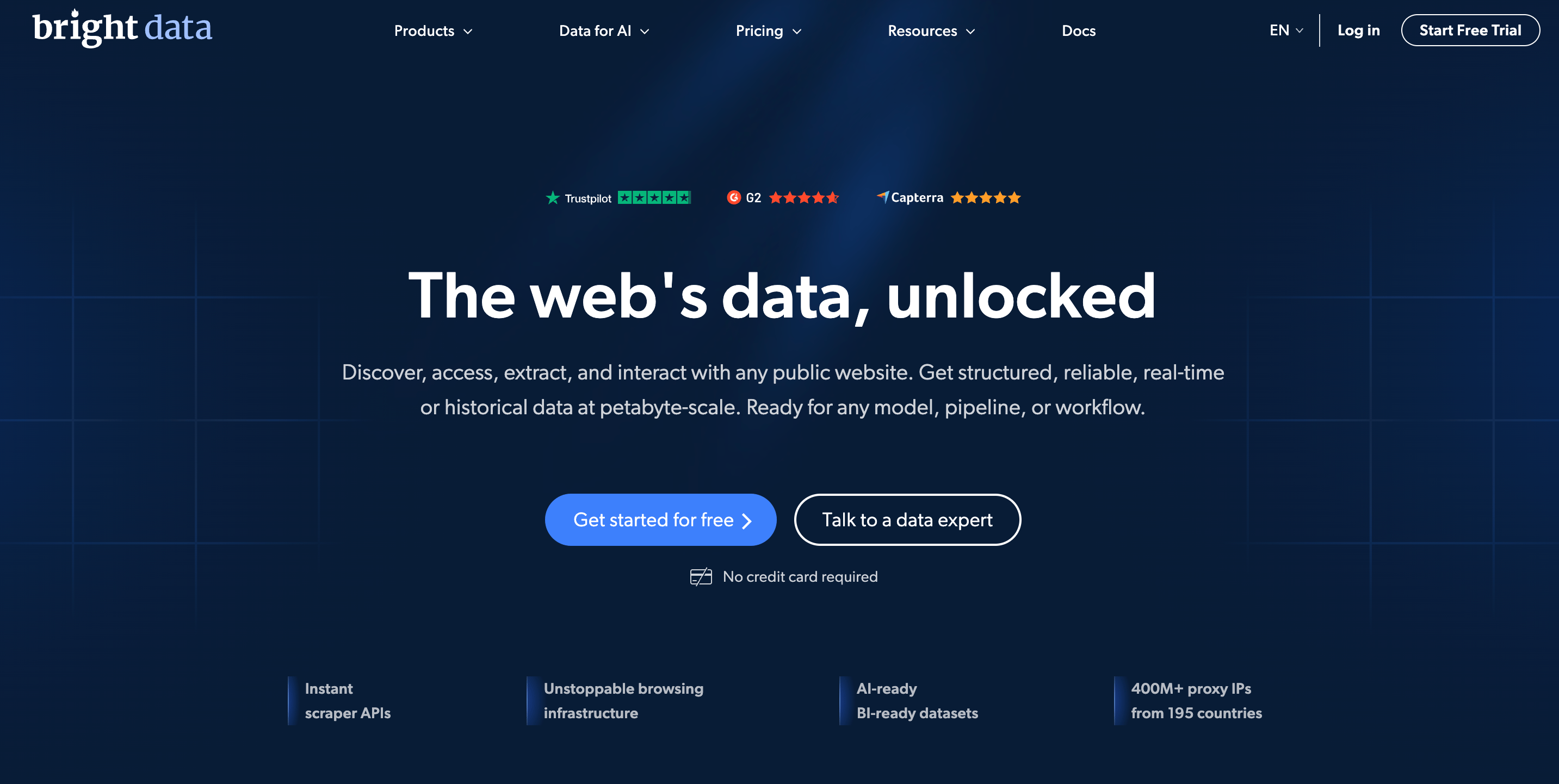
Bright Data hit $300M ARR in late 2025, targeting $400M by mid-2026—from web scraping infrastructure. The company operates the world's largest proxy network (150M+ IPs, 195 countries, 98.44% success rate).
Lead Generation ($10K-$50K/month): Automated pipeline scraping LinkedIn, directories, job boards. Enrich with contact info, tech stack, funding. Margins: 75-85%. Example: Deliver qualified leads at $50 each. 500/month = $25K revenue. Infrastructure cost via Bright Data: $500-$2K/month.
Price Monitoring ($5K-$25K/month): Real-time competitor tracking, automated pricing adjustments. Margins: 80-90%. Monitor 1,000 products, update every 6 hours. Clients increase revenue 8-15%. Charge $15K/month. Tech: Bright Data's 437+ pre-built scrapers + algorithms.
AI Training Data ($50K-$200K/month): Large-scale data collection for LLM training, sentiment analysis. Margins: 70-80%. Example: 10M product reviews at $0.50 each = $5M contract. Infrastructure cost: ~$500K.
The arbitrage: Building in-house costs $350K-$400K/year. Using Bright Data: $6K-$50K/year. Charge enterprise rates, capture 75-90% margins. The companies making money aren't building infrastructure—they're building vertical-specific data products on commodity infrastructure.
TOP AI FUNDING ROUNDS
Where the Smart Money is Moving?
Company | Amount | Key Details |
|---|---|---|
Harvey | $500M+ | Legal AI, $190M ARR, 100K lawyers at 1,300+ orgs, $5.55B+ valuation |
Qualified Health | $125M Series B | Hospital AI workflows, NEA-led, deployed at Mercy/Emory/Jefferson Health |
Granola | $125M Series C | AI productivity/note-taking, $1.5B valuation, Index Ventures led |
Adonis | $40M Series C | Healthcare revenue cycle AI, outcome-based pricing, Quadrille Capital led |
Spade | $40M Series B | Financial transaction data enrichment platform |
Trayd | $10M Series A | Construction back-office automation, 14hrs→30min payroll, White Star Capital |
Moda | $7.5M Seed | AI design agents with brand compliance, General Catalyst led |
Airbase | $5M Seed | RF spectrum coordination for gov/military/commercial, a16z led |
Total: $1.3B+ across 8 deals (March 19-26, 2026)
The Pattern
Healthcare + legal captured $665M (51%). Specialized AI for regulated industries with complex workflows. Not consumer apps—enterprise infrastructure with compliance moats.
Outcome-based pricing is the new SaaS. Adonis charges for revenue recovered. Trayd sells time savings. Qualified sells cost reduction. VCs fund measurable workflow transformation, not AI features.
Production deployments, not pilots. Qualified live at major health systems. Harvey serves 1,300+ orgs. The market shifted from "can it work?" to "how fast can we scale?"
Vertical beats horizontal. Zero horizontal platforms raised capital. Every deal: legal AI, healthcare AI, construction AI, fintech AI, design AI, RF AI. The pitch that works: "we automate [specific workflow] in [specific industry] with measurable ROI."
What Founders Need
Three things to raise in 2026:
1. Measurable outcomes: Not "20% more accurate." Instead: "14 hours to 30 minutes" or "$X million recovered." VCs fund ROI.
2. Production deployments: "Processing 2 million patient interactions monthly at Mercy" counts. Beta with 3 hospitals doesn't.
3. Regulatory moats: Legal, healthcare, construction, fintech, RF spectrum—heavily regulated with high switching costs. Domain expertise, customer relationships, regulatory clearances take years to replicate.
The capital is there. $1.3B in one week proves it. But it's deployed with discipline. Revenue, production scale, measurable outcomes. The "fund the vision" era is over.
Next week: Why vertical AI companies achieve $1.5B+ valuations with 10-person teams, and the three moats that work in enterprise sales.
How was this edition? |
We hope you enjoyed this Latestly AI edition.
📧 Got an AI tool for us to review or do you want to collaborate?
Send us a message and let us know!
Was this edition forwarded to you? Sign up here